A Market Morning Without a Shopping Mission
A market morning without a shopping mission can reveal how a neighborhood connects through its market, from working entrances to useful public routes.
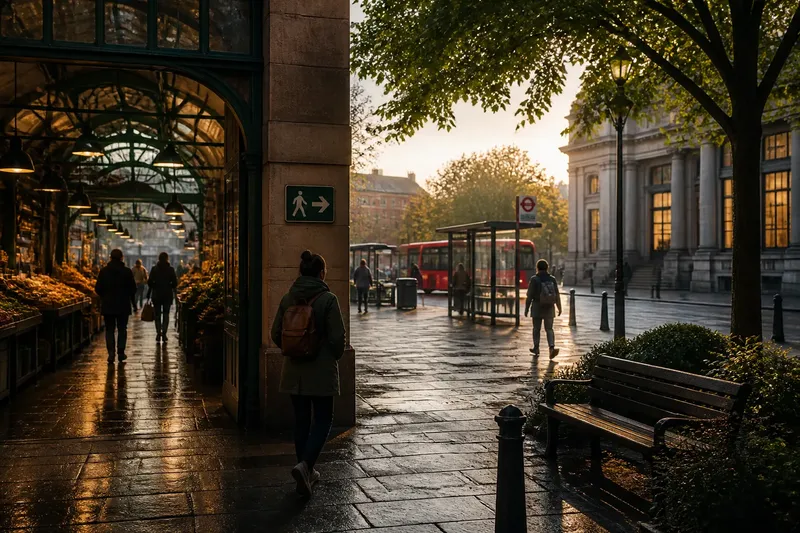
The most common mistake on a market morning without a shopping mission is treating the place like a set of stalls to inspect; the cost is missing how it works as part of the neighborhood. Instead of tracing its aisles, choose one question about the market’s role: Does it connect two streets, bring people to a shared square, or give a busy block a place to pause?
Market routes
Start with a map or the market’s public access information, then identify the streets and transit stops around it. You are not plotting a route through every stall. You are looking for the market’s relationship to its surroundings: whether people can pass through, whether it has a clear public entrance, and which nearby places it links.
At the market, stay in public areas and look for signs that explain access. A covered arcade may connect a plaza to a side street; an indoor hall may have one public entrance and separate service doors. Those details affect whether the market works as a shortcut, a destination, or both. Follow posted rules, and keep clear of loading areas.
Say you arrive at a fictional market beside a library and a bus stop. The public map shows an entrance on the library side, while signs at the site direct visitors away from a service gate. You enter through the marked doorway, then leave toward the bus stop. The result is a usable route between two neighborhood landmarks, without assuming that every door is open to visitors.
Market boundaries
A market’s edge can be more revealing than its busiest aisle. Notice where the market’s public space meets a sidewalk, square, transit stop, or neighboring business. Look for changes in paving, shelter, signs, and access. These clues help distinguish a public route from a work area or a space meant for customers.
Also notice what happens at the boundary. A bench or broad plaza may provide room to wait without blocking shoppers. A narrow doorway may make passing through awkward when people are carrying bags. Do not linger in entrances or photograph people at close range without asking. The useful observation is about the place’s design, not the private business of the people in it.
Useful observations
- If the public entrance opens onto a sidewalk with a marked crossing, note that route as a clear pedestrian link; if the crossing is absent or difficult to identify, use a marked crossing elsewhere instead.
- If a posted sign identifies a public passage, follow it to understand where the market connects; if a door is marked for staff or deliveries, do not use it and return to the public route.
- If the market has a seating area outside the main flow, treat it as a suitable place to pause; if seating is inside a narrow passage, keep moving and find a less obstructive spot.
- If a bus stop or public transit entrance is visible from the market’s public edge, check its signs for the onward route; if the stop is not clearly marked, consult a transit map rather than guessing.
- If the same public path links the market to a nearby square, note it as a possible through-route; if barriers or access signs interrupt it, use the surrounding public sidewalk instead.
- If directions from staff or vendors confirm that an area is open to visitors, continue within those boundaries; if access is unclear, ask before entering or leave that area alone.
Questions about markets?
Can I walk through without buying anything?
That depends on the market’s access rules. Read posted signs and ask staff if the public route is unclear; do not enter a restricted area just to look around.
How can I tell whether a market is a shortcut?
Check for public passage signs and note where the marked route begins and ends. If the route is closed or restricted, take the surrounding sidewalk instead.
What should I bring for a short visit?
Comfortable shoes and a phone with a map are usually enough for an informal look at public routes. A notebook is optional; one note about a useful connection can be more helpful than a record of every stall.
What is not worth the effort?
Trying to map every stall or entrance adds little if your aim is to understand the neighborhood connection. Focus on the public approach and exit, and leave work areas and private conversations alone.
Leave with a route
Before leaving, check your understanding against a public map or the market’s signs. If the route you followed is shown as public, you can remember it as a convenient connection. If the map or signs suggest it is restricted, do not rely on it as a shortcut; use the surrounding streets.
A market morning without a shopping mission can be useful for more than browsing: it can show how a shared place fits into everyday local routes. Keep one practical detail in mind, such as which public entrance leads toward the bus stop or where the market opens onto a square. That is enough to make your next visit easier without turning the market into a project.