The Little Pause That Makes a Walk Feel Like a Journey
A little pause can turn an ordinary walk into a journey by helping you notice how each bend, slope, bridge, or change in view reshapes the route.
The common mistake on an ordinary walk is treating every pause as lost time. That can leave you with the distance covered but little sense of where you went; a brief stop at a bend or a change in ground lets the route register as a sequence of places. A little pause on a walk is not a break from the journey. It is how the next part comes into view.
Try thinking of a familiar path as a string of scenes, each with a threshold: a lane gives way to a riverside track, a slope opens onto rooftops, or gravel becomes a narrow footbridge. The pause belongs at that change, not at an arbitrary interval. You do not need a viewpoint or a special destination. You need a moment to notice what the route has just become.
Three approaches work particularly well: pause at a change in view, at a change in terrain, or at the point where one route choice gives way to another. Each creates a different kind of journey, and each suits a different mood.
Pause at a view
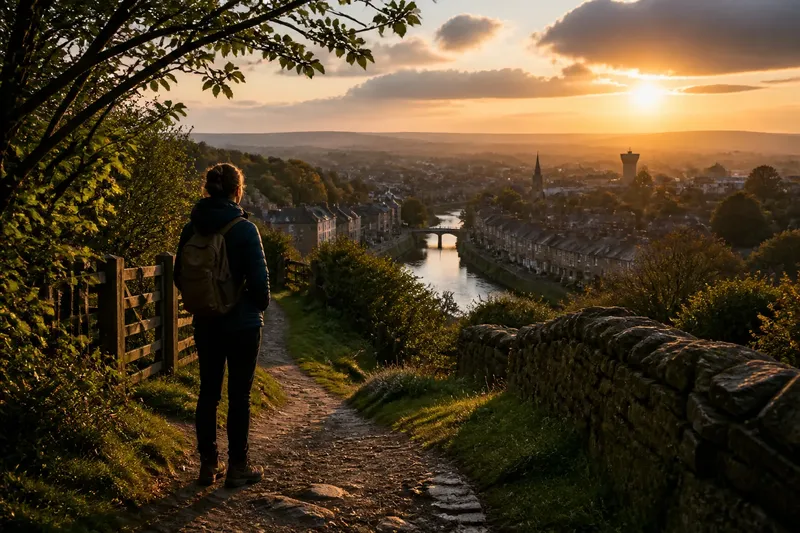
When a path opens from a close, enclosed stretch into a broad view, give your eyes time to adjust. A gap in hedges might reveal a water tower, a line of hills, or the roofs of a neighborhood you thought you knew. The useful pause is not simply “stop and admire the scenery.” It is a chance to connect the new view with the ground you have just crossed.
Look back first. What did the path conceal? Which bend, tree, wall, or rise marked the moment the view changed? Then look ahead. Pick one feature—a church roof, a strip of river, a pale field—and notice how the route points toward it or turns away. These small comparisons make the landscape feel joined to the walk rather than displayed in front of it.
This approach suits walkers who like orientation, skyline details, and the pleasure of seeing familiar streets from an unexpected angle. It also works for a short neighborhood loop: a gap between buildings can offer a more revealing change of view than a formal overlook.
Say you are walking from a row of houses toward a canal path. At the last gap between garden fences, you stop, look back at the roofs, then follow the canal’s line toward a footbridge. The expected result is a clearer sense of how the quiet path connects to the neighborhood, rather than a vague memory of having reached the water.
Pause at a terrain change
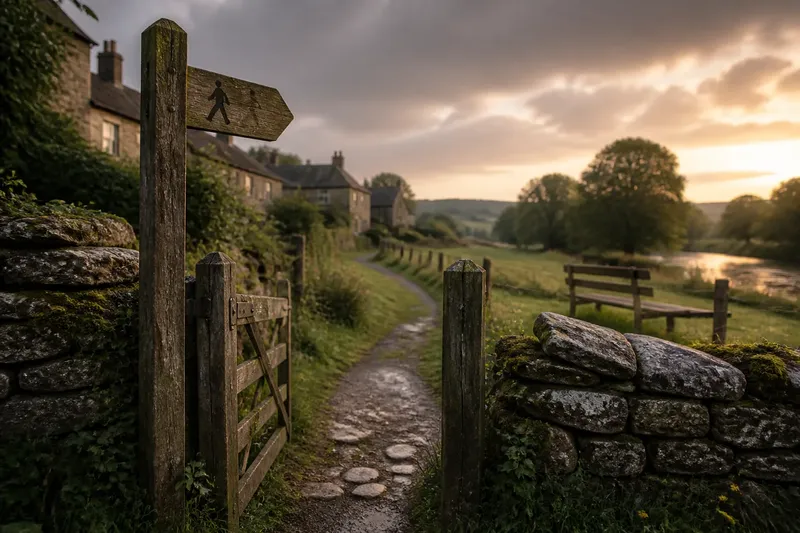
A path changes character underfoot before it changes on a map. Smooth pavement may become loose gravel; a flat towpath may climb a short bank; a soft track may meet a wooden boardwalk. Pause just before the transition, then notice how the surface changes your stride, your attention, and the sounds around you.
This is not a reason to inspect every footstep. One deliberate stop is enough to mark a meaningful shift. Is the ground firmer or springier? Does the slope make you shorten your stride? Does the boardwalk carry footfalls differently from packed earth? These are immediate observations, not measurements. They give your memory a physical marker: the route turned from easy pavement to a quiet, yielding track.
Terrain pauses suit walkers who enjoy texture and movement more than far-off views. They are especially useful on routes where hedges, buildings, or trees keep the horizon close. A change in surface can create a distinct chapter even when the scenery seems almost unchanged.
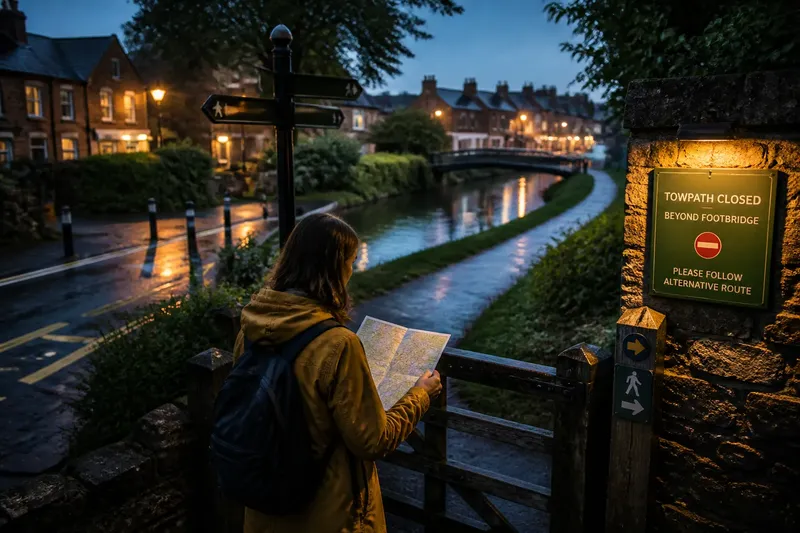
Stay clear of narrow entrances and keep the route open for others. If a surface looks wet, unstable, or difficult to pass safely, do not stop in the way or step onto ground you cannot assess. Take the pause on a wider, stable section nearby instead.
Pause at a route choice
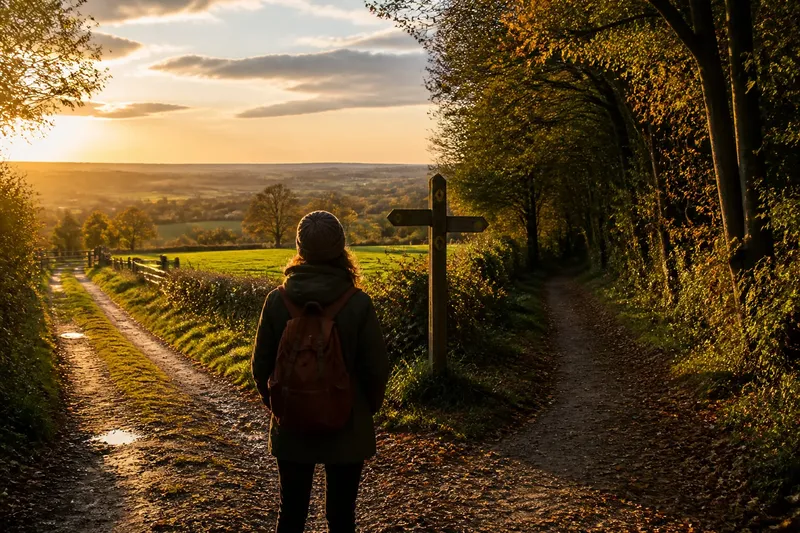
A fork, bridge, gate, or meeting of paths can make a walk feel like a journey because it asks you to notice direction. Stop where you can stand safely without blocking anyone. Look at the path you have come along, the options ahead, and the features that help distinguish them: a stream, a row of trees, a distant road, or a signpost.
You do not need to turn every walk into a navigation exercise. If your route is already planned, a junction can still mark a transition. One path may follow the stream while another climbs toward houses; the choice you make gives the next stretch a character. If you are uncertain about access or directions, check a reliable map or local signs before continuing rather than guessing at a restricted or unclear way.
This approach suits curious walkers who enjoy the shape of a route and want to understand how paths connect. It can also help someone who tends to walk on autopilot: a junction invites a small decision, even if the answer is simply to continue straight.
Which pause suits you?
How long should a walking pause last?
Stay only long enough to notice one or two details and let the next stretch take shape in your mind. If you begin checking your phone or feel you are waiting for something to happen, start walking again.
Where should I pause on a familiar route?
Choose a place where something changes: a view opens, the ground shifts, or a path divides. A familiar route can feel newly legible when you mark the transition instead of stopping at the same convenient spot every time.
What if there is nowhere comfortable to stop?
Keep moving slowly through the change and look from a wider, safer place nearby. A pause is useful only when it leaves you room to stand without blocking the path or disturbing the surroundings.
Should I take a photo during the pause?
Take one if it helps you remember the view, but notice the scene before framing it. A phone can flatten a route into a set of pictures if every pause becomes a search for the best shot.
For a simple way to choose, ask what you most want from this outing. Choose a view pause if you want to connect distant features with the path. Choose a terrain pause if you want to feel how the ground shapes the walk. Choose a route-choice pause if you want to understand where the paths lead. You can use more than one, but a single well-placed stop often gives a short walk enough structure.
Make the pause count
Keep each stop specific. Name one thing behind you, one thing ahead, and the change between them. “The lane narrowed beside the brick wall, then opened toward the river” is more useful than “nice view.” You are building a small account of movement, not composing a travel diary.
Leave some things alone. There is no need to photograph every threshold, research every building, or turn a quiet walk into a route audit. The pause works because it is light: notice, connect, continue. If a detail catches your interest, remember it for another outing rather than interrupting the walk to chase every question.
On your next walk, choose one transition before you set off: a bend, a slope, a bridge, or a break in the buildings. When you reach it, look back once and forward once. That small pause can make the familiar path feel like a sequence of places, with a beginning, a change, and a direction worth following.